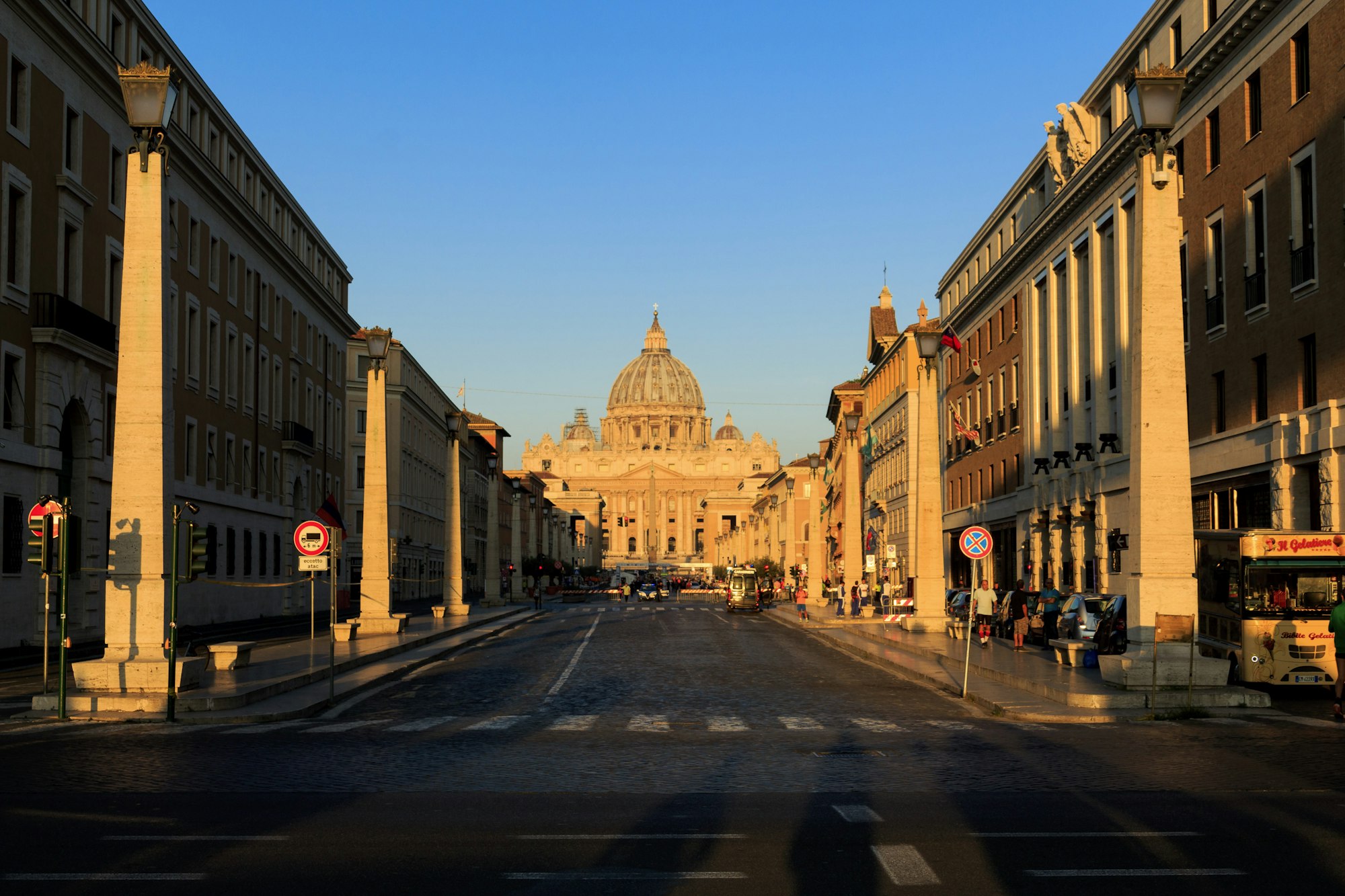
empty road in front of a building during golden hour
i

City guide

Rome city guide: itinerary, costs and local tips

Ancient Rome, the Vatican and one slow neighbourhood day, arranged so you never cross the city twice in the same afternoon. Days 1–3 are the core trip; days 4 and 5 add the Appian Way, Testaccio and the villas of Tivoli.

Travellers who want the landmarks but refuse to spend the trip queueing.

Share this guide:

Free offline PDF pocket guide

Get the full Rome plan — day by day, official prices, transport tips and red flags — on your phone with no internet or roaming needed.

Where to sleep

A mid-range hotel in Monti or Trastevere — Monti is closest to the ancient sites; Trastevere is better for evenings. Budget around €120 per night for two.

Day by day

Days 1–3 are the core trip. Staying longer? Days 4–5 carry on from the same base, with their own cost breakdown below.

  1. Day 1 — Ancient Rome

    ~€210
    Morning.
    Colosseum with a timed entry booked in advance, then the Roman Forum on the same ticket.
    Afternoon.
    Palatine Hill, then down through Monti for a late lunch.
    Evening.
    Dinner in Monti, a short walk from most of the day's sites.
  2. Day 2 — Vatican and the river

    ~€230
    Morning.
    Vatican Museums at the first slot of the day, finishing in the Sistine Chapel.
    Afternoon.
    St Peter's Basilica, then a walk along the Tiber to Castel Sant'Angelo.
    Evening.
    Cross into Trastevere for dinner and a wander through the lanes.
  3. Day 3 — Centre at walking pace

    ~€180
    Morning.
    Pantheon with a €5 timed entry ticket (book online for weekends), then Piazza Navona and a coffee standing at the bar like a local.
    Afternoon.
    Campo de' Fiori market and supplì or pizza al taglio on the walk, then Isola Tiberina and the lanes of Monti for carciofi alla romana in season.
    Evening.
    Spanish Steps and Piazza di Spagna in the late light, then the Trevi Fountain after dark when the crowds thin, and a final plate of cacio e pepe nearby.
  4. Day 4 — The Appian Way and Testaccioif you stay longer

    ~€170
    Morning.
    Bus 118 to the Via Appia Antica, the Roman road lined with tombs and umbrella pines. Visit the Catacombs of San Callisto, then rent a bike at the park office to ride the original basalt paving. Reason to go: on a weekday morning you have a 2,000-year-old road almost to yourself.
    Afternoon.
    The Parco degli Acquedotti, where six Roman aqueducts cross open fields — free, and where Romans walk their dogs. Metro A back towards the centre.
    Evening.
    Testaccio, the old slaughterhouse quarter and the home of cucina romana: coda alla vaccinara or rigatoni con la pajata at a family trattoria. Reason to go: these quinto quarto dishes were invented here and are rarely done well elsewhere.
  5. Day 5 — Tivoli: Villa d'Este and Hadrian's Villaif you stay longer

    ~€190
    Morning.
    Cotral bus or regional train to Tivoli, about an hour. Villa d'Este first, at opening, for the Renaissance gardens and hundreds of fountains on the terraces.
    Afternoon.
    Hadrian's Villa below the town, the emperor's private city of pools, baths and theatres. Lunch in Tivoli on porchetta from the nearby Castelli Romani and a glass of local white.
    Evening.
    Back in Rome for a last aperitivo on the Gianicolo terrace, then pizza romana — thin and crisp — in Trastevere.

What it costs

Accommodation (3 nights)
€360
Food and drink
€260
Sights and museums
€170
Local transport
€50
Buffer
€40
Total for 2 travellers
€880

Estimates for 3 days in Rome, excluding flights. Always confirm live prices and opening hours before you book.

Staying 5 nights instead

Five days in Rome costs about €1,390 for two, excluding flights. The extra two days are cheaper than the core: the Appian Way and the aqueducts are free, and the biggest new costs are two hotel nights and the Tivoli villas.

Accommodation (5 nights)
€600
Food and drink
€430
Sights, catacombs and Tivoli villas
€220
Local transport and Tivoli bus
€80
Buffer
€60
Total for 2 travellers
€1,390

Like this rhythm? Get one built around your dates, budget and interests.

Plan my Rome trip →

Before you fly

The things worth sorting early

Nothing here is required — it is simply the order most travellers wish they had booked things in.

Best time to visit Rome

Spring (Apr–May)

Recommended
  • 17–25°C
  • High crowds
  • Normal rates

Pleasant walking weather; book sights early.

Summer (Jun–Aug)

Peak season
  • 29–33°C
  • Very high crowds
  • Highest rates

Hot; plan outdoor ruins for early morning.

Autumn (Sep–Oct)

Recommended
  • 20–27°C
  • Moderate crowds
  • Good value

Warm days and the harvest-season food calendar.

Winter (Nov–Mar)

Budget-friendly
  • 8–15°C
  • Low crowds
  • Lowest rates

Shorter queues; some days are rainy.

April, May, late September and October: warm, long days and manageable queues. August is hot and many neighbourhood restaurants close. January and February are the cheapest and the Vatican queues almost disappear.

Getting in from the airport

Cheapest.
Terravision or SIT coach from Fiumicino to Termini, about €7, 55 minutes.
Fastest.
Leonardo Express train to Termini, €14, 32 minutes, every 15 minutes.

Where to stay in Rome

Monti.
walking distance to the Colosseum with a local evening scene — around €110–150 a night for two.
Trastevere.
dinner and bars, a bridge away from the centre — around €100–140 a night for two.
Prati.
calm streets near the Vatican, better value rooms — around €90–130 a night for two.

Getting around

A 72-hour Roma pass for transport is €18; single tickets are €1.50 for 100 minutes. Walking is faster than the bus in the historic centre almost every time.

What to skip

  • Skip queueing at the Colosseum on the day — timed tickets sell out and the on-site line can be two hours.
  • Skip the restaurants directly on Piazza Navona and around the Pantheon; two streets back the same plate costs a third less.

Deep Research: verified sights & local spots

What travellers consistently praise and warn about, checked against recent reviews.

Colosseum, Roman Forum and Palatine

Very positive
  • + One ticket covers all three sites
  • + The 08:30 slot beats both the heat and the crowds
  • ⚠ Timed tickets sell out days ahead
  • ⚠ Visitors mention street resellers near the metro — for more certainty, book on the official site

Insider tip. Buy only on the official Colosseum site and start with the Forum if the arena queue is long.

Book tickets

Vatican Museums and Sistine Chapel

Positive
  • + Raphael's Rooms and Michelangelo's ceiling
  • + The early slot reaches the Sistine Chapel before the groups
  • ⚠ Shoulders and knees must be covered
  • ⚠ Very crowded from mid-morning
  • ⚠ Closed on most Sundays

Insider tip. Book the first slot directly with the museums and walk through to the Sistine Chapel before stopping anywhere else.

Book tickets

Pantheon

Very positive
  • + The best-preserved building of ancient Rome
  • + Only €5 with a short visit
  • ⚠ No longer free — timed entry, book weekends online

Insider tip. Go at opening on a weekday and look up at the oculus before the square fills.

Book tickets

Mercato di Testaccio

Very positive
  • + Romans' own market with stalls for supplì and trapizzini
  • + Fair prices, few tourists
  • ⚠ Most stalls close by mid-afternoon and all day Sunday

Insider tip. Come at lunchtime for a trapizzino and a plate of Roman pasta at the market counters.

Find on Google Maps

Trattoria Da Enzo al 29, Trastevere

Positive
  • + Classic carbonara, cacio e pepe and carciofi
  • + Small family trattoria
  • ⚠ No bookings for many tables — long queues
  • ⚠ Cramped seating

Insider tip. Arrive 15 minutes before it opens for lunch or dinner to get in on the first sitting.

Find on Google Maps

AI-generated synthesis of public reviews (Tripadvisor, Google Maps, Booking.com, Reddit); not Wayfare.live's opinion. Last AI analysis update: October 2026 · Review & rating disclaimer

Staying longer?

With 5 days add Ostia Antica (€3 train, €18 entry, quieter than Pompeii) and a slow day in the Appia Antica park with the catacombs.

Different number of days? Build a plan for exactly your trip length.

Plan my Rome trip →

Rome for couples: romantic spots

Three days in Rome works well as a romantic trip if you build each day around one unhurried evening instead of a long list of sights. These are the spots worth timing for sunset, and where to eat afterwards without landing in a tourist trap.

Giardino degli Aranci and the Aventine Keyhole.
The orange garden on the Aventine looks straight across the rooftops to St Peter's dome and is free. Arrive 45 minutes before sunset, then walk two minutes to the Knights of Malta keyhole, which frames the dome down an avenue of hedges. Queues for the keyhole are short before 19:00.
Pincio Terrace above Piazza del Popolo.
The best golden-hour view in the centre, and a 10-minute walk from the Spanish Steps. Come up through the Villa Borghese gardens, stay for the light on the twin churches below, then walk down into the centre for dinner.
Ponte Sisto at night.
The quiet crossing into Trastevere, with the river lit on both sides. It costs nothing, takes five minutes and is the nicest way to arrive for dinner on your second evening.

For dinner and a drink, walk past Piazza di Santa Maria in Trastevere and into the lanes north of Via della Lungaretta — Vicolo del Cinque, Via del Moro and Piazza de' Renzi. Two courses and a carafe of wine run about €55–70 for two, against €90 or more for the same food on the main square. Aperitivo before 20:00 is around €8–10 a glass; book dinner for 20:30 or later and you will avoid the set-menu tables aimed at tourists.

Seeing Rome without feeling rushed

Rome feels rushed only when you cross the city twice in one day. This plan groups the sights geographically and puts the two ticketed giants at the very start of their mornings, which is what buys you slow afternoons.

Colosseum, 08:30 timed entry.
Book the first slot online with the Forum and Palatine on the same ticket. You are through the ancient sites by early afternoon, when the queues outside are at their worst, and the light is far better for photos.
Vatican Museums, first slot of the day.
Reserve the 08:00–08:30 entry directly with the museums. You reach the Sistine Chapel before the tour groups, then exit to St Peter's, where security lines are shortest before 11:00 and after 16:00.
Walk the centre, take the metro across it.
Pantheon, Piazza Navona, Campo de' Fiori and Trevi sit within 20 minutes of each other on foot, and walking is faster than the bus there. Use metro line B only for the hop between Termini and the Colosseum, and line A between the centre and the Vatican.
Keep one loose block a day.
Two fixed sights plus one long lunch is a full Roman day. Leave the late afternoon unplanned for a nap, a market or a coffee standing at the bar — that gap is the difference between seeing Rome and enduring it.

What 3 days in Rome costs for two

What two people actually spend across three days and three nights in Rome, excluding flights. These are mid-range, real-world numbers, not the cheapest possible trip.

Accommodation, 3 nights
€360

A mid-range double in Monti, Trastevere or Prati at about €120 a night.

Food and drink
€260

Coffee and pastry at the bar, a light lunch, and dinner with wine each evening — roughly €43 per person per day.

Sights and tickets
€170

Colosseum, Forum and Palatine combined ticket plus the Vatican Museums for two, with one extra paid site.

Local transport
€50

Airport transfer both ways plus a handful of metro rides; the rest is walking.

Buffer
€40

Gelato, a taxi in the rain, a museum you did not plan on.

Total: about €880 for two, or €440 each. Travelling in January or February pulls the accommodation line down by roughly a third; a July trip pushes it up by about the same.

Worth knowing

  • Book the Colosseum and Vatican Museums online — walk-up queues can cost you an entire morning.
  • The Pantheon is no longer free: entry is €5 with a timed slot, and weekend visits should be booked online in advance.
  • The Vatican dress code is enforced at the door of St Peter's Basilica and the Sistine Chapel — shoulders and knees covered for everyone.
  • On Wednesdays the Papal Audience fills St Peter's Square and the basilica only reopens to visitors around 12:30–13:00; plan the Vatican for another morning or go in the afternoon.
  • Refill your bottle at the nasoni, the cast-iron street fountains running free cold drinking water all over the centre.
  • Eat the four Roman pastas while you are here — carbonara, cacio e pepe, amatriciana and gricia — plus supplì and pizza al taglio between sights.
  • Coffee costs less standing at the bar than sitting at a table, sometimes by half.
  • The historic centre is compact; most days here need nothing but comfortable shoes.

Rome questions, answered

How much does 3 days in Rome cost for two people?
About €880 without flights: €360 for three nights, €260 on food, €170 on tickets to the Colosseum, Forum and Vatican Museums, €50 on transport and €40 of buffer.
Is 3 days enough for Rome?
It is enough for ancient Rome, the Vatican and the historic centre at walking pace — days 1 to 3 of this plan. Days 4 and 5 add the Appian Way, Testaccio and a day trip to Tivoli, which is the right length if you want Rome beyond the headline sights.
When is the best time to visit Rome?
Spring and autumn. July and August are hot and crowded, while November to February is quiet and cheap if you can accept short days and some rain.
Do you need to book tickets in advance in Rome?
Yes for the Colosseum and the Vatican Museums. Timed entry slots regularly sell out several days ahead and walk-up queues can take a whole morning.
Where should you stay in Rome for three days?
Monti puts you minutes from the ancient sites, Trastevere is better for evenings. Both keep you inside walking distance of most of this plan.
Is 3 days in Rome enough for a romantic couples trip?
Yes. Three days covers the Colosseum, the Vatican and the historic centre at walking pace, and still leaves each evening free. Time sunset at the Giardino degli Aranci on the Aventine or the Pincio terrace above Piazza del Popolo, then cross Ponte Sisto for dinner in the lanes behind Piazza di Santa Maria in Trastevere, where two courses and wine cost about €55–70 for two.
How do you see Rome in 3 days without feeling rushed?
Group each day geographically and book the two ticketed giants at the first slot of the morning: an 08:30 Colosseum entry with the Forum on the same ticket, and the 08:00–08:30 Vatican Museums slot so you reach the Sistine Chapel before the tour groups. Walk the historic centre, where it beats the bus, use metro line B for Termini to the Colosseum, and leave one loose block each afternoon.
How much does a 3 day trip to Rome cost for two people?
About €880 for two, excluding flights: €360 for three nights in a mid-range double, €260 on food and drink, €170 on the Colosseum, Forum and Vatican tickets, €50 on airport transfers and metro rides, and €40 of buffer. That is roughly €440 each, and a January trip cuts the accommodation line by about a third.
Do you have to pay to enter the Pantheon in Rome now?
Yes. The Pantheon stopped being free and now costs €5 with a timed entry slot; EU residents under 25 pay a reduced rate and under-18s enter free. On Saturdays and Sundays you should book the slot online in advance, because on-the-day tickets for the weekend often run out by late morning.
What is the dress code for the Vatican and St Peter's Basilica?
Shoulders and knees must be covered for both men and women, and the rule is checked at the security line for the Vatican Museums, the Sistine Chapel and St Peter's Basilica. Take a light scarf or a pair of long shorts in summer — people are turned away every day for vest tops and short skirts.
Can you visit St Peter's Basilica on a Wednesday morning?
Usually not. The Papal Audience takes over St Peter's Square most Wednesday mornings and the basilica stays closed to sightseers until around 12:30–13:00. Either put the Vatican on another day, go on Wednesday afternoon, or collect a free ticket and attend the audience itself.
What food should you eat in Rome in 3 days?
Work through the four Roman pastas — carbonara, cacio e pepe, amatriciana and gricia — and eat supplì and pizza al taglio standing up between sights. In winter add carciofi alla romana, braised with wild mint and garlic, in a Monti or Testaccio trattoria. A plate of pasta runs €12–16 away from the main squares.
Can you drink the tap water in Rome for free?
Yes. Rome has around 2,500 nasoni, the cast-iron street fountains that run cold, safe drinking water day and night. Carry a refillable bottle and you will spend nothing on water — a real saving in July and August, when bottled water near the Colosseum costs €2–3.
What should you add on days 4 and 5 in Rome?
Day 4 is the Appian Way: bus 118 to the Via Appia Antica, the Catacombs of San Callisto, a bike ride on the Roman paving and the free Parco degli Acquedotti, with dinner in Testaccio. Day 5 is Tivoli, about an hour away, for Villa d'Este and Hadrian's Villa. Five days costs about €1,390 for two.
How do I get from the airport into Rome?
Terravision or SIT coach from Fiumicino to Termini, about €7, 55 minutes. If you would rather not carry bags on public transport: leonardo express train to termini, €14, 32 minutes, every 15 minutes.
Is Rome walkable?
Largely, yes — this plan is built so each day is walkable with at most a couple of short transport hops. A 72-hour Roma pass for transport is €18; single tickets are €1.50 for 100 minutes. Walking is faster than the bus in the historic centre almost every time.
Where should I stay in Rome?
Monti for walking distance to the Colosseum with a local evening scene (€110–150 a night); Trastevere for dinner and bars, a bridge away from the centre (€100–140 a night); Prati for calm streets near the Vatican, better value rooms (€90–130 a night). This plan budgets €120 a night for two.
Working to a fixed budget? Read our step-by-step guide to planning a trip on a budget.

Want this tailored to your own dates and pace?

Plan my Rome trip →

Still torn? Read our Rome vs Paris comparison →

Thinking about another city?

Check any place before you book

Deep Research reads thousands of real reviews of a hotel, restaurant or sight and flags the red flags for you before you commit.

Explore Deep Research

Your dates, your budget

Wayfare.live builds the same kind of plan around your own dates, budget, hotel standard and interests — with booking links for every stay, restaurant and sight.

Plan my trip
Share this guide: